
IMAGICS
Isotope iMAGing for Ice Core Science
Project
The "Isotope iMAGing for Ice Core Science" (IMAGICS) project aims at pushing the resolution of water stable isotopes analysis to the millimeter-scale on both horizontal and vertical dimensions of ice core samples by developing the analytical framework for the image reconstruction of the isotopic features in ice cores.

Why stable isotopes analysis of ice cores?
For more than 50 years, ice core analysis has been one of the primary tools for investigating past climate variability.
The stable isotopic composition of ice cores provides quantitative information on past temperature, atmospheric circulation, and hydrological processes.
Accessing the high-frequency isotopic signals preserved in ice cores is essential for identifying abrupt and rapid climate fluctuations, such as Dansgaard-Oeschger events during the last glacial period, and for extracting climate information from extremely thinned ice layers, for example in the deepest sections of the Beyond EPICA (BEOI) and Talos Dome ice cores in Antarctica.
Consequently, both ice core processing strategies and analytical resolution are among the most critical parameters in ice core research.
How to access high resolution information?
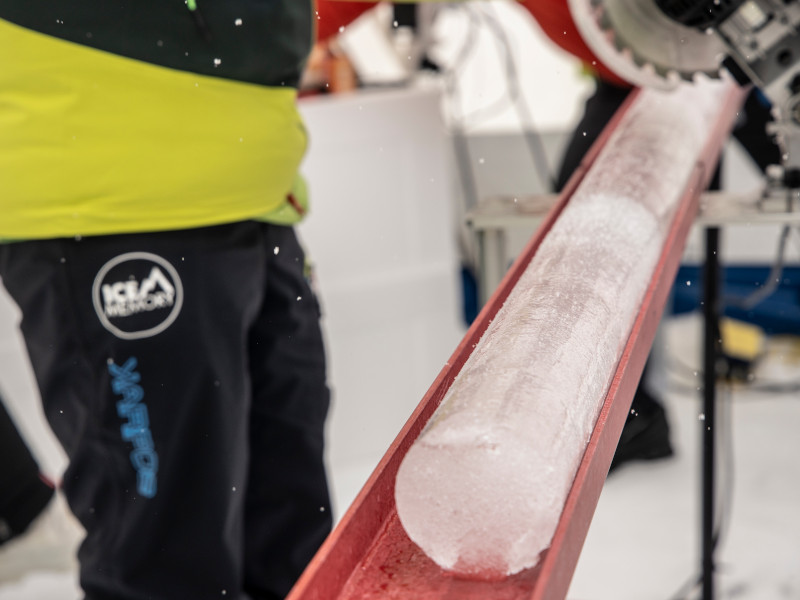
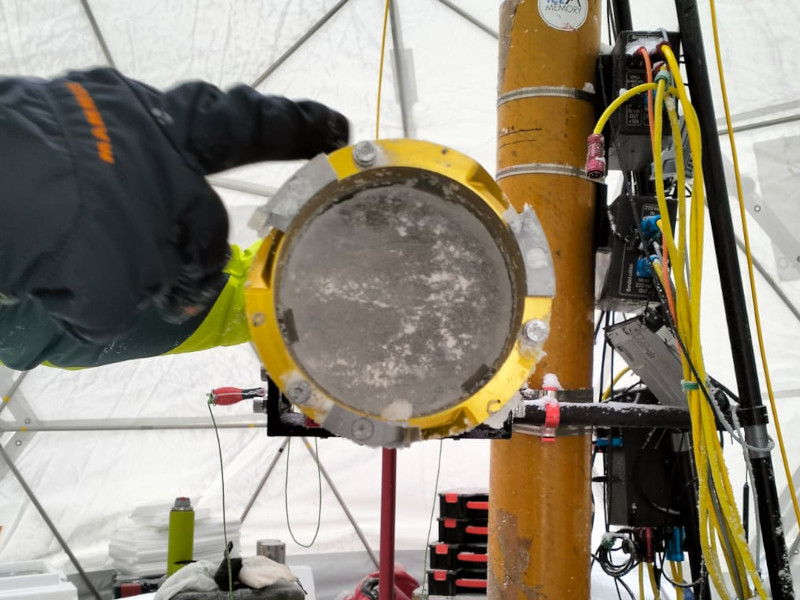
IMAGICS develops a novel approach to high-resolution isotopic imaging that enables unprecedented spatial and temporal reconstruction of climate signals archived in ice. This approach is based on coupling two well-established analytical techniques: Laser Ablation for micro-destructive sampling of geological materials, and Cavity Ring-Down Spectroscopy for stable water isotope analysis.
What is Laser Ablation?
Laser Ablation (LA) occurs when a high-fluence laser beam interacts with the surface of a material, producing a plume of aerosol and gas that can be analyzed by downstream analytical techniques, most commonly Inductively Coupled Plasma mass spectrometry (ICP-MS). LA is particularly attractive because it is quasi-non-destructive while allowing high spatial resolution and high analytical throughput. Only recently has LA-ICP-MS been demonstrated as a powerful high-resolution tool for ice core studies, especially for the characterization of dust and chemical impurities.
What is Cavity Ring-Down Spectroscopy?
Cavity Ring-Down Spectroscopy (CRDS) is a highly sensitive optical technique used to measure trace gas concentrations and their isotopic composition (e.g., δ¹⁸O and δD for water). In CRDS, a laser pulse is injected into an optical cavity formed by highly reflective mirrors, where light undergoes thousands of reflections. The decay rate of the light intensity (the “ring-down” time) depends on the absorption characteristics of the gas within the cavity. The advent of CRDS has substantially enhanced analytical precision and sample throughput in geophysical and glaciological research. Notably, CRDS has enabled continuous, high-resolution isotope measurements of ice cores through continuous-flow analysis, in which ice is melted (hence lost) and the resulting water vapor is analyzed in real time.
Challenges and project strategy
Coupling LA and CRDS presents several technical challenges. First, ice exhibits low absorbance at the typical wavelengths used in excimer laser ablation systems (e.g., 193 nm), resulting in limited sample production and requiring precise and highly repeatable control of laser fluence at the ice surface. Second, nanosecond laser pulses may induce thermal effects and heat diffusion within the ice matrix that need to be taken into account for proper signal interpretation. Finally, LA and CRDS systems operate on very different temporal scales (milliseconds versus seconds), necessitating careful synchronization between sampling and detection.
These challenges will be addressed within IMAGICS through a series of controlled laboratory experiments using artificial ice samples with well-characterized isotopic compositions. This systematic approach will allow the isolation and quantification of individual effects before applying the methodology to natural ice core samples.
Objectives
The IMAGICS project focuses on the following operational objectives:
- obtaining stable and repeatable water vapor pulses through ablation of both artificial and natural ice core samples, enabling precise and reliable CRDS isotope measurements;
- developing an isotope signal-processing framework capable of
- accurately resolving true isotopic variability under transient conditions,
- converting time series of water vapor isotopic composition into two-dimensional images of the ice surface isotopic structure;
- developing reproducible methods for producing ice standards with homogeneous and well-characterized isotopic composition for LA-CRDS applications.
The achievement of these objectives is expected to:
- advance the understanding of the physical interactions between laser radiation and ice surfaces;
- improve knowledge of isotopic effects associated with ice sublimation and ice formation processes during laser ablation;
- assess the presence, structure, and significance of isotopic patterns within ice core cross sections;
- provide new insights into past climate variability at exceptionally high spatial resolution, including in extremely thinned ice core sections.
Methodology
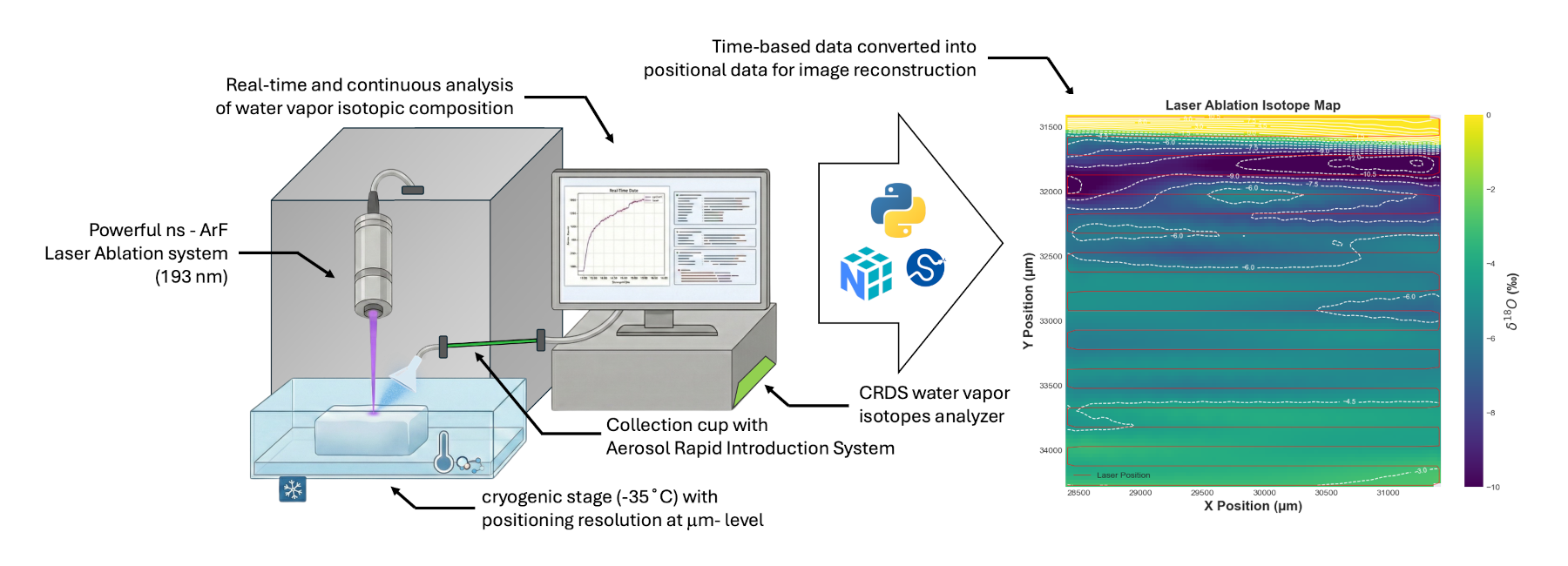
Overall, the IMAGICS project aims to push the performance limits of commercially available CRDS analyzers and ns LA systems by integrating:
- advanced laser-based isotope spectroscopy (L2130-i CRDS analyzer, Picarro);
- micro-scale, micro-destructive analytical techniques (Analyte Excite+ ns LA system, Teledyne Photon Machines);
- controlled laboratory experiments using well-defined isotopic standards;
- quantitative modeling of isotope transport, mixing, and diffusion within the coupled LA-CRDS system.
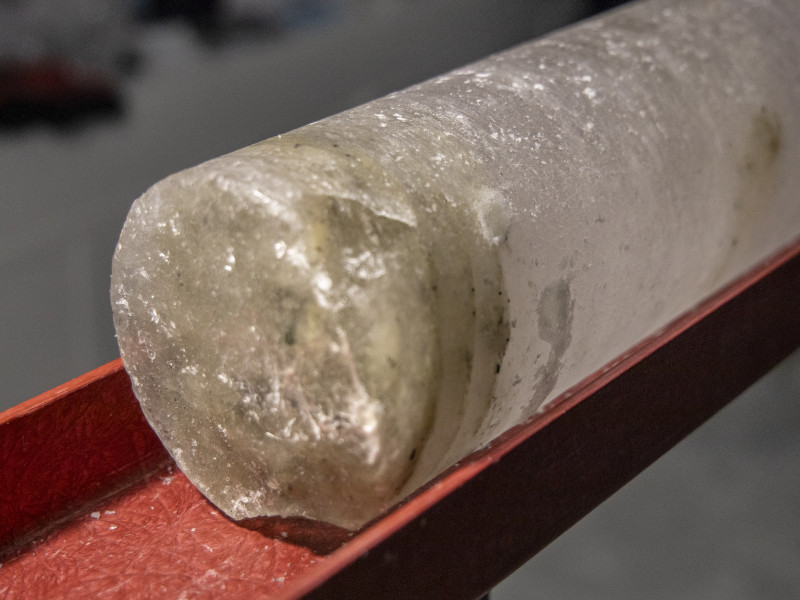
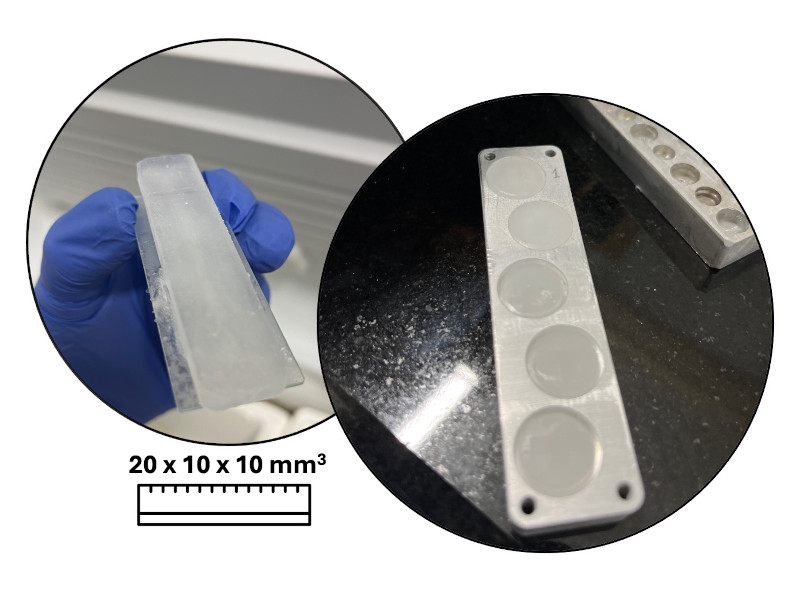
A sketch of the LA-CRDS configuration and one example of the expected result (an isotope map) are shown in figure 4. Actual samples just before the analysis are shown in figure 5.
Outreach
- IMAGICS will be presented at the EGU General Assembly 2026 "Optimizing Laser Ablation–CRDS Coupling for Spatially-Resolved Millimetric Isotopic Measurements on Ice Cores". Display time Monday, 4 May 2026, 14:00-18:00 Hall X5, X5.202
- Meet us at EWLA 2026 (Cryo Lunch seminar), 7-10 July 2026